According to story, Newton encountered some ridicule when he broke the news on Calculus. If we can imagine him giving Power Point presentation to a conference, we might see him taking a hard question from the audience…
“Isaac, is that dx zero or non-zero?”
That dx is a butterfly we can’t catch. It is never zero but it moves as close to zero as it wants to be and what Isaac realized was, we need to change our strategy: don’t chase one differential–chase two!
Alice could write a poem for the line y=3x:
- We know that ‘dx’ escapes us
- by being as close to zero as it wants to be
- but it can’t elude ‘dy’
- which is always “dx times three”
So if we relax and let ourselves fall down the rabbit hole to this story, might it cross our minds, several centuries later, to use Newton’s strategy?
We begin with the idea we hear, several times, that something with curvature is flat locally. You may have heard that this is the definition of a manifold. You may have heard that General Relativity says that locally the math of Special Relativity is true.
Well, how far away from a point on a manifold does this “local” extend?
Set your coordinate system so that the point of interest is zero. Now ask, is the approach of dx close enough to put dx in the neighborhood of “local”? You can shout “home free!” if you are dx and you get close enough to be “in the neighborhood.
On a straight line segment every point has the same derivative. Perhaps for some scenarios we can consider that to be why “local” is the the runway and “dx” is a plane that needs it to land. We need merely get the plane to the runway and then we can tell the pilot “go for touchdown”.
Now we just need to do it.
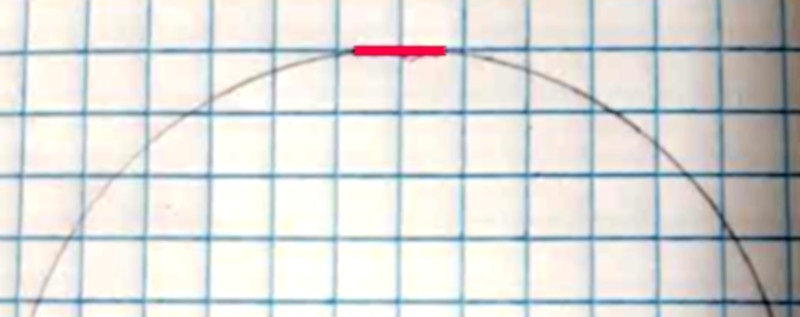
We decide to inscribe n-polygons in a circle. the area of the n-polygon can never exceed the area of the circle and the perimeter of the n-polygon can never exceed the circumference of the circle.
With an infinite number for n, the length of “end” of each polygon is a differential and our n-polygon gives us the values for area or circumference, thus it is equal to the circle and the “end” of each polygon IS the local flatness. Congratulations for making it this far–take another swig of your drink!
 Vectoreverything