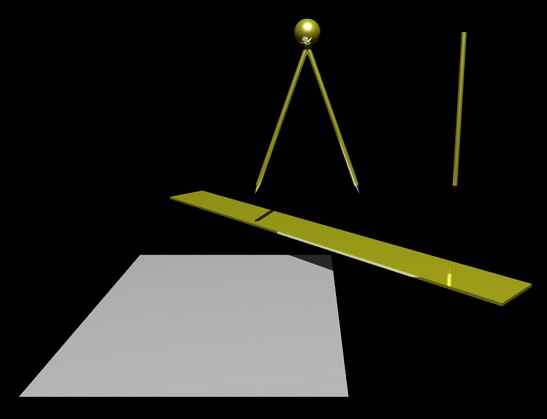
Geometry is the set of techniques we can perform on paper using a pencil, a straight edge and a compass. Geometry is also the collection of facts about shapes.
Point
A point has no size, but it has a location.
The intersection of two lines is a point. We may also use line segments and arcs to create the intersection. (Elsewhere we will consider curves to be lines and we will say straight lines are just a subset).
The ends of a line segment are points.
We cannot draw two points and then add them together to make a point (as will be the case for vectors).
We can subtract a point from a point and the result is a vector. There will be some discussion on this, discussion of the kind that says “you have to real specific about what certain words mean in this setting”.
It is typical in Physics to subtract an initial point from a final point.
We are cheering you as you notice that in Physics the differences which lead to vectors are the important things in the equations. It was important that your position changed by 200 miles as the clock moved ahead two hours–we want the change in position and the change in time.
Line
Typical Geometry classes use the word line for straight lines. This provides a convenience. It may surprise a reader reading something written hundreds of years ago to find an author using lots of words to make sure it is understood that the line he talks about is a straight line.
The formula “y = mx + b” where m is slope and b is y-intercept is one of the general formulas for a line.
Line Segment
A line segment is a collection of an infinite number of points. It is terminated by points on both ends. A line segment may be defined by stating the locations of the two endpoints. We can go a step further and make it a vector by defining one point as “initial” and the other as “final”.
Length
Your first exposure to the idea of length was probably a ruler.
With a straight edge and a compass, you can arbitrarily set a unit length (distance between the two ends of the compass) and you can draw ideas related to length. You can even draw your own ruler.
Rectangle
A rectangle is formed from two sets of parallel lines and all four interior angles are perpendicular. A rectangle can be characterized by the values for its width and its length, and the area of rectangle is the calculation below, where a is area, w is width and l is length:
a = wl
Square
If all four sides of a rectangle are equal length, then it is a square. The area of a square is its width squared. Alternately, we can think of this as a=wl where l=w:

Area
You probably already know how to calculate the area of a rectangle: area = length times width.
Triangles
A triangle is a math object formed from three connected line segments.
Right Triangle
A Right triangle is a triangle that has a 90 degree angle.
 Vectoreverything