- Not every matrix is a rank 2 tensor.
- Not every vector is a rank 1 tensor.
“I am a rank 2 tensor. That matrix over there is just a collection of numbers.”
If you aspire to be a vector, you go through a process where you say “I want components–what numbers do I need, so that when they are multiplied against my basis vectors, I am the vector I claim to be?”
A vector needs to be scaled to units, and this might be done by drawing the vector on graph paper. If this route is taken, a vectors length can be given in graph paper units and additional information may be available in the form of relating a unit of graph paper to a known unit of length such as inches.
If we want to draw a vector with a length of 10 inches, we will probably draw it to 10 units and in some way tether the information that 1 unit corresponds to 1 inch.
When we are taught about one-forms, we can look at an example of the math (we show one below) and see that the one form is scaled to the unit vector. In the problem below 


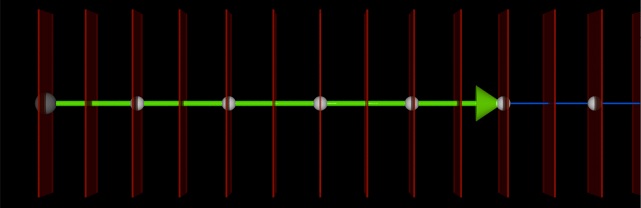
The above one-form is (2,0).
 Vectoreverything