Special Calculus introduces the ideas of Differentiation and Integration using functions that are straight lines.
- y=k
- y=mx
- y=mx+b
Differentiation
Differentiation calculates the point slope of a function at a specific point. If our function is a line, then the slope between any two points in the function is the same, and the point-slope of any point is equal to this value. (This will make more sense later when you are shown a trick to get a point slope when the function is “curvy”.)
y = k
This function is a horizontal line. Assume this is a function of your position. You are in a restaurant at a table at position x equals 50 and you’re sitting there for five minutes eating. Every minute a computer record your position.
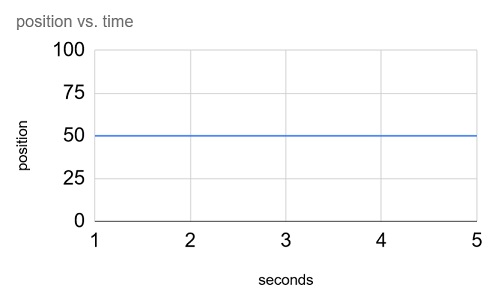
The function is y=50 and the slope of this line is 0, it should make sense that for the 5 minutes your velocity with 0 feet per second in the X Direction the entire time.
y = mx + b
Now change the story, you walk with velocity of 1 meter every two seconds in the positive x direction to get to the food bars (it is an all you can eat buffet restaurant). This journey, at a constant velocity, takes ten seconds.
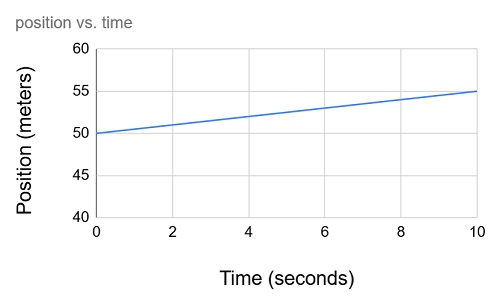
The function is y = 0.5x + 50 and the slope of this line is 0.5. It should make sense that your velocity in this story is 0.5 meters per second in the positive x direction.
y = mx
Now for a coordinate transformation. What if we repeat the above story but we change the coordinates so that we are now sitting at x=0? That is like pushing the button to reset the trip odometer.
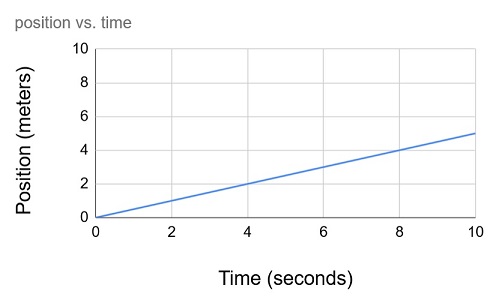
The function is y = 0.5x and the slope of this line is 0.5. We would argue that this is a simplification that you want to do every chance you have. Start the time at time = 0. Start with position = 0. There may be a situation where you change your frame of reference so that you start with velocity = 0.
Integration
Assume we travel at 100 km/hr for 4 hours. It should make sense that you would travel 400 kilometers.
We plan to use the page Calculus as a second stage, with extensive explanation of calculus with Monomial Functions and Trigonometric Functions.
 Vectoreverything