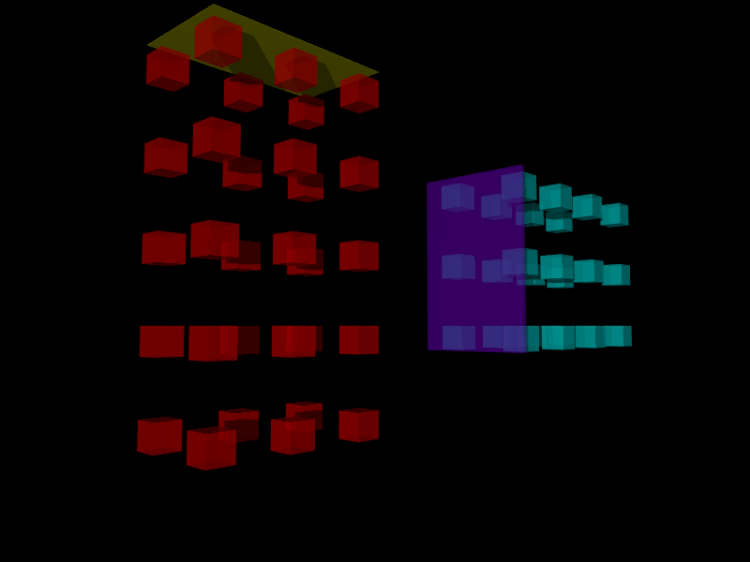
The answer to the question “what is a tensor” is a journey that will take you through several regions of math world.
A tensor is an array of numbers that has to pass a series of tests before it can be certified as being a tensor. To understand a tensor, we must cut it apart and thoroughly study several properties that we find.
- Tensor Invariance
- Linear Transformations
- Linear Algebra Topics
- Index Notation
- Multivariable Calculus Topics
- Linear Mappings
Some of the words that build the description of a tensor are used in other ways that shock us, even by people who are respected for having written math textbooks that are very helpful.
To counter this problem we have a set of tests for tensors and anything that was built improperly will fail. To do these tests you must be familiar with index notation, but index notation the preferred way to work with tensors so it was already on your to-do list.
We can tell you that a vector is a tensor if it carries with the correct geometry story. (We must be able to describe the vector using an initial point and a final point.)
We can mention that the metric tensor is a tensor. We don’t show you an array with numbers because there are as many different metric tensors as there are different frames of reference that we wish to use.
Part of the reason for the strictness is the desire to use Tensor Calculus in Physics; Tensor calculus won’t alter the physics story. Tensor Calculus will change a length from 10 inches to 25.4 centimeters; we can call it a change but the length was never altered.
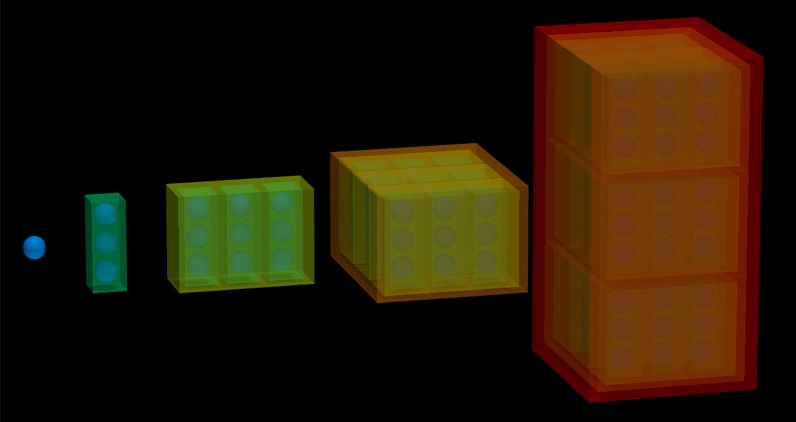
We characterize tensors by rank. Rank is NOT the same thing as the number of dimensions. You may find an author saying “2D tensor” when it is referring to a “Rank 2 tensor”. A rank 1 tensor, represented by a vector, has as many dimensions as there are numbers in it:
- (x,y) 2 dimensions
- (x,y,z) 3 dimensions
- (t,x,y,z) 4 dimensions
All of the above are rank 1 tensors.
We may have a matrix that represents a tensor. It will be a rank 2 tensor. Here a twist, it will be one of the following:
- (2,0)
- (1,1)
- (0,2)
Things like this are the reason you can’t just look at an array of numbers and know what it is.
We can imagine tensors with ranks 3 and higher. You might come up with ways to stack each new rank. An artist has done so in the picture below. Soon, you or one of your friends will realize that your choices were arbitrary and somebody working elsewhere is making different choices. There would be a need to standardize to a choice, except..
When a computer does the math it doesn’t look at how component numbers are stacked. The computer demands demands for every component to be identified by the indices of the array and it uses those when it does the calculation.
(carved in stone)If a linear transformation is a tensor then its components transform according to tensor transformation laws when we impose a change of coordinates.
The above could be as simple as a displacement changing from 10 to 25.4 when we change from inches
Further of Tensors will be directed towards Basis Vectors and Transformation Matrices.
 Vectoreverything